
Before Recycling: How to Retain the Value of Products and Resources
CERMA Knowledge Hub | Circular Economy in Practice
When we talk about the circular economy, the first thing that comes to mind is recycling waste. But the circular economy means much more: its goal is to keep products, their components and materials in the economic cycle for as long as possible and to retain as much of the value already created as possible.
That is why recycling is necessary, but it is not always the first or best option.
What value lies behind every product?
Making any product requires not only raw materials, but also energy, water, technology, design, logistics and human labour. When a product becomes waste prematurely and is sent straight to recycling, a significant part of the resources and value invested in making it is lost.
If a product can be repaired, reused or refurbished, the value already created in it stays in the economic cycle for longer. This is one of the key principles of the circular economy — keeping a product and its function in use for as long as is practically possible.
What happens before recycling?
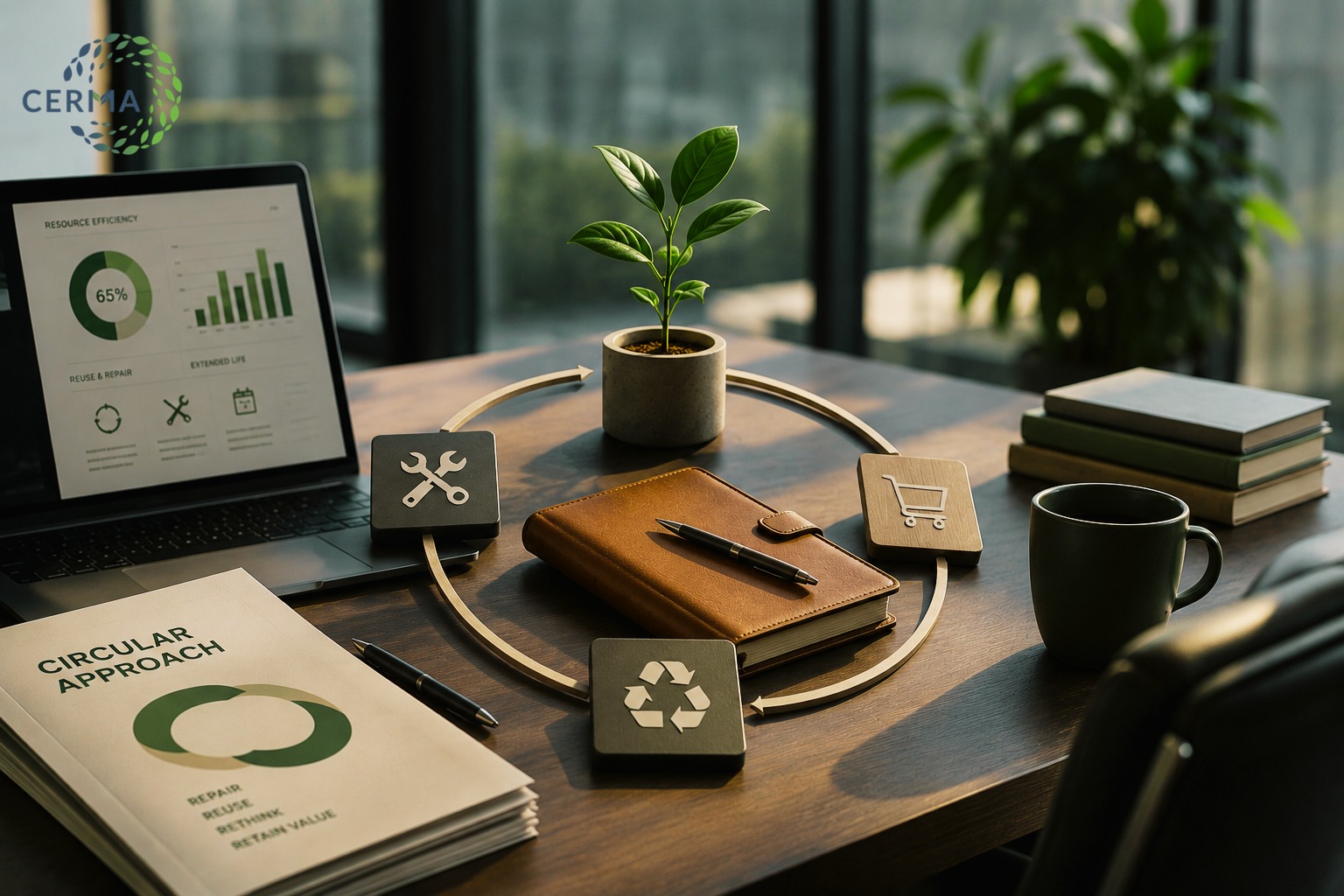
The technical cycle of the Ellen MacArthur Foundation’s well-known “butterfly diagram” shows that there are several ways to retain a product’s value:
- Sharing — a product is used jointly or in turn by several users.
- Maintenance and repair — extending a product’s life through regular care and the repair of damaged parts.
- Reuse — a product is used again by the same or another user while retaining its main function.
- Refurbishment and remanufacturing — restoring a used product or its components and returning them to the economic cycle.
- Recycling — processing a used product and returning the resulting secondary raw materials to production.
The logic is simple: the longer a product and its components stay in use, the less of the value invested in them is lost. With recycling, the material can return to production, but part of the labour, energy and technological value already invested in making the product is still lost.
Recycling is therefore an important component of the circular economy, but we should turn to it only once the other options for retaining the value of a product and its components have been exhausted.
What does this mean for business?
A circular approach encourages businesses to think about potential waste before it is generated. Accordingly, the question “How do we recycle this product?” should only arise at the final stage of the process.
With a circular approach, it is important for a business to ask a few key questions:
- Can the product’s useful life be extended?
- Can it be repaired or upgraded?
- Can the product be reused or passed on to another user?
- Can its individual components be restored and used again?
- Can a take-back, rental or resale model be introduced for the product?
- And only then — how can the materials that can no longer be used in any other way be recycled?
Such an approach is not only about environmental responsibility. It can reduce dependence on raw materials and the associated costs, extend the period of product use and create opportunities to develop additional services and new sources of revenue.
There are still many opportunities before recycling
The circular economy does not reject recycling. On the contrary, it is essential when it is impossible to retain a product, its components or its function. The difference lies in the priorities.
The linear model works on a simple principle:
take a resource → make → use → throw away.
The circular model, by contrast, seeks to keep products and materials in the economic system for as long as possible and to reduce waste generation from the outset.
That is why the main question of the circular economy is not just “How do we recycle waste?”
It is more important to ask:
“How can we retain the value of products and resources so that they become waste as late as possible?”
Source: Ellen MacArthur Foundation — The Technical Cycle of the Butterfly Diagram
Note: This publication was prepared on the basis of an international source and adapted by CERMA.